
Germany’s real estate landscape is undergoing a transformation that discerning investors should closely monitor. The latest comprehensive data reveals a market consolidation creating compelling opportunities for those who can read beyond the headlines and understand the structural forces reshaping capital deployment opportunities.
The Numbers Tell a Compelling Story
Bottom Line Up Front: The German real estate market is experiencing a quality-focused consolidation that creates exceptional opportunities for strategic investors who understand the underlying fundamentals.
Development Pipeline Consolidation: Seasonal variation in demand
The development pipeline has contracted from 516 to 422 projects—an 18% decline that represents seasonal market fluctuations. Planning phase projects dropped 25.3%, but this reflects more selective capital deployment and enhanced due diligence across a market that saw building permits plummet to just an average of 15K/month in the first 5 months in 2025 —far below the required average of 30K/month permits needed per month.
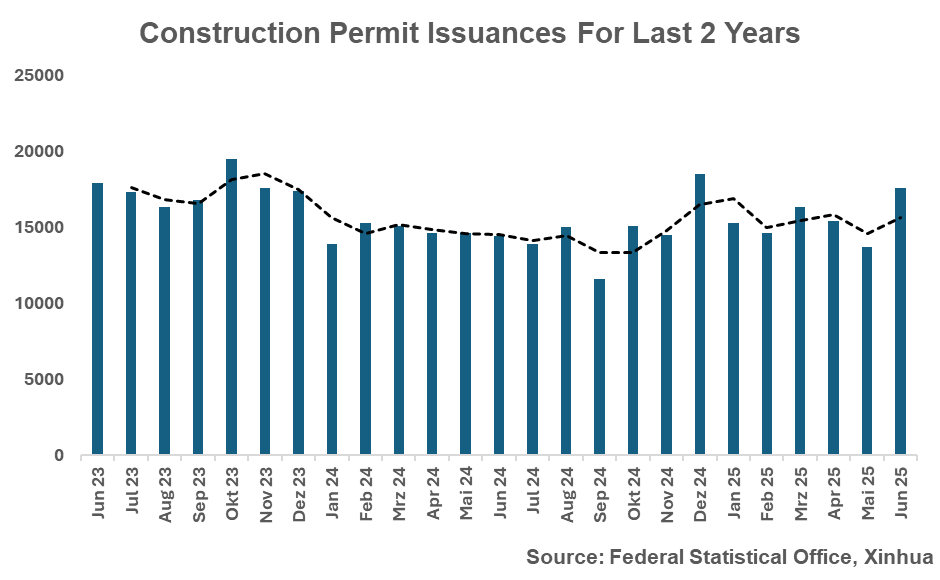
Key Supporting Data:
- Building permits for new dwellings dropped 17% year-over-year in 2024, marking the third consecutive annual decline
- Single-family home permits plunged 26.6% to just 25,300 units
- Multi-family housing approvals slumped 19.6%, leaving just 75,400 new apartments in the pipeline
This consolidation isn’t market weakness—it’s market evolution. Developers are increasingly focusing resources on projects with stronger fundamentals, better locations, and clearer value propositions. The result is a more concentrated but higher-quality opportunity set that rewards investors who can identify and partner with the right development teams.
The Supply-Demand Mathematics Are Undeniable
The Federal Institute for Research on Building, Urban Affairs and Spatial Development (BBSR) estimates Germany needs 2.56 million new units by 2030—approximately 320,000 annually. Against this requirement, construction completions dropped to 251,937 residential units in 2024, marking a 14.42% year-on-year decline.
The Supply Gap Reality:
- Required: 320,000 units annually through 2030
- Delivered in 2024: 251,937 units
- Annual Shortfall: 68,063 units minimum
- Cumulative Shortage by 2030: Over 400,000 units
This isn’t a temporary imbalance—it’s a structural mathematical reality that creates sustained upward pressure on valuations and rental rates.
Policy Winds Creating Institutional Tailwinds
The new conservative government has appointed Construction Minister Verena Hubertz with a clear mandate: deliver a “housing construction boost.” Her comprehensive plans include streamlining approval procedures, promoting modern construction techniques, and expanding land availability.
Concrete Policy Measures Include:
- Simplified Building Type E regulations (cabinet approval November 2024)
- €2 billion investment in affordable housing construction through 2026
- Consolidated housing subsidies into streamlined channels
- Public guarantees to reduce financing costs for developers
- Temporary reinstatement of EH-55 energy efficiency standards
This policy shift directly addresses Germany’s most persistent challenge: regulatory complexity that has historically extended development timelines. With government commitment to acceleration, investors can expect more predictable project delivery schedules and reduced regulatory risk.
Market Fundamentals Demonstrate Resilience
Property Price Recovery: The Data Confirms the Trend
Property prices across Germany are rising again, with apartments up 3.2%, single-family homes increasing 4.7%, and multi-family homes leading with 8.7% year-over-year growth. Commercial property prices rose 2.3% in Q1 2025, building on Q4’s 0.5% growth—marking two consecutive quarters of appreciation.
Price Recovery by Segment (2025):
- Multi-family properties: +8.7% YoY
- Single-family homes: +4.7% YoY
- Apartments: +3.2% YoY
- Commercial properties: +2.3% (Q1 2025)
Despite recent gains, German property prices remain significantly below their 2022 peak levels, with apartments sitting 11.4% below peak in nominal terms (18.2% when adjusted for inflation). This creates an attractive entry point for strategic investors.
Rental Market Strength: Sustained Demand Fundamentals
The share of German households renting rather than owning increased from 47.5% in 2014 to 52.2% in 2024, with rental growth moderating to 3.5% in 2024 from 5.0% in 2023. Gross rental yields for apartments in Germany average 3.82% as of Q1 2025, with the highest yields in Leipzig (4.99%), Berlin (4.76%), and Stuttgart (4.49%).
Rental Market Performance Indicators:
- Current rental yield: 3.82% average (Q1 2025)
- Rental growth 2024: 3.5% (moderated from 5.0% in 2023)
- Tenant households: 52.2% (up from 47.5% in 2014)
- Average tenancy duration: 11 years (providing income stability)
Investment Market Recovery: Capital Is Returning
The German residential investment market continued its recovery throughout 2024, with larger residential portfolios (30 units or more) generating €9.3 billion in transaction volume, making residential the strongest asset class ahead of logistics (€6.9bn), retail (€6.3bn), and office (€5.2bn).
Transaction Volume by Asset Class (2024):
- Residential: €9.3 billion
- Logistics: €6.9 billion
- Retail: €6.3 billion
- Office: €5.2 billion
Demographic Drivers: Population Growth Fuels Demand
Germany’s population has grown 5% over the past 10 years, reaching 84.7 million in 2023, with BNP Paribas Real Estate projecting a 5% rise in A-cities (Munich, Hamburg, Düsseldorf, Berlin, Cologne, Frankfurt, Stuttgart).
Population Growth Projections:
- National: 5% growth over past decade (84.7M in 2023)
- A-cities: +5% projected growth
- Large cities (250k+): +2% growth expected
- Medium cities (up to 100k): -1% decline projected
This demographic shift concentrates demand precisely where supply constraints are most acute, creating sustained rental market pressure in major metropolitan areas.
The Strategic Opportunity: Convergence of Favorable Conditions
Financing Environment Improvement
Mortgage rates have moderated to 3.5-5% following ECB rate cuts, while a February 2025 Reuters survey of 13 market analysts projected a 3.5% year-on-year increase in average house prices for 2025.
Quality Premium Validation
The pricing gap between new construction (€5,478/sqm) and existing stock (€3,403/sqm) demonstrates sustained premium valuations for quality assets—a €2,075 per square meter differential that reflects buyer preferences for modern amenities, superior energy efficiency, and lower maintenance requirements.
Energy Efficiency Value Creation
Urban properties in Germany with access to EV charging stations are seeing 10% higher resale values in 2025, while demand for energy-efficient homes is expected to grow by 20%.
Risk-Adjusted Return Opportunity
With ECB rate cuts providing market support, government policy accelerating development processes, and structural undersupply creating pricing power, we’re witnessing a convergence of favourable conditions. The combination of:
- Supply constraints: 68,000+ unit annual shortfall
- Policy support: €2B government investment + regulatory streamlining
- Improving financing: 3.5-5% mortgage rates (down from peaks)
- Demographic tailwinds: 5% population growth in target markets
- Investment recovery: €9.3B residential transaction volume leading all asset classes
This creates an environment where strategic partnerships and disciplined capital allocation offer exceptional risk-adjusted returns.
For sophisticated investors, this quality-over-quantity evolution isn’t a challenge—it’s precisely the market inefficiency that creates alpha. The consolidation has reduced competition while maintaining strong underlying demand fundamentals.
The question isn’t whether opportunities exist, but whether you’re positioned to capitalize on them through strategic partnerships with quality developers, disciplined market timing, and a clear understanding of the structural forces reshaping Germany’s real estate landscape.
Data sources: Federal Statistical Office (Destatis), BNP Paribas Real Estate, Global Property Guide, Deutsche Bundesbank, JLL, BBSR, Reuters Market Survey